Monday, 3 June 2013

The Love of Saffron Cake

This week I discovered Slow Food. Founded in Italy in 1989, the Slow Food Movement  is 
...a global, grassroots movement with thousands of members around the world that links the pleasure of food with a commitment to community and the environment.

In the fast modern junk food environment, Slow Food is the voice of calm reason and quality. We work to promote the greater enjoyment of food through a better understanding of its taste, quality and production.
Slow Food UK runs educational projects and has a local group network which promotes the Slow Food way of life at a local level. One of its campaigns is the Forgotten Foods Project, which 'travels the country collecting small-scale quality produce threatened by industrial agriculture, environmental degradation and homogenization.' As they point out, 'Those artisan producers who opt to swim against the tide of ‘fast life’ need [...] help in explaining to the public why their products are special and, usually, cost more to make than mass-produced counterparts.' Sounds like a great idea to me. And I was delighted to discover that one of their targeted foods is the Cornish Saffron Cake.

Now, the Saffron Cake is part of my childhood. Not only was I born and brought up in Cornwall, but my grandparents and parents, along with my uncle, ran a family bakery. Saffron cake is in my blood. Apparently, when I was about three I was asked what I would like for my birthday tea, and my reply was 'Bread and butter and sashron cake.' And it still has a place at my special-occasion tea table, nearly fifty years later.

There are various recipes for Saffron Cake. As far as I'm concerned there are four basic characteristics that it must have to be entitled to the name. It must be loaf shaped. The dough must be yeast-based. It must have plenty of currants and my personal taste is to have a good helping of sultanas and/or raisins as well. As my mother-in-law says, it's no good if it's a 'station cake' - one currant here and then you have to go miles to get to the next one! And it must be that deep fragrant yellow that you can only get by using plenty of saffron. I'm afraid that the Saffron Cake on the Slow Food website is far too pale for me: you would never have seen one as wishy-washy as that at Trethewey Bros Bakers!

The Saffron Crocus
Picture Credit

It's interesting that such an exotic and expensive spice came to be so much part of the culture of a small rural society in one of the farthest corners of the UK. From Medieval times, though, saffron was grown in Cornwall, and production was still going on in Bude in the C19th. Saffron is the dried stigma of the Crocus Sativus, and it takes about 150 flowers, all harvested by hand, to produce just 1g of the spice. No wonder saffron is incredibly expensive - in fact, there is a commonly held myth that ounce for ounce it is more expensive than gold. This isn't quite true, however, as current gold prices are around £30,000 per kilo, whereas saffron is only £4,500! Still - pretty expensive. My mother remembers my grandfather keeping the saffron in a shiny metal box in the bakery safe, because it was the most precious thing on the premises.

Of course all this reminiscence about Saffron Cake meant I had to make one. So here's the recipe for the cake I made this weekend.

Saffron Cake

1 tsp dried saffron (real saffron threads, not 'saffron powder' - and don't skimp!)
125ml milk
500g plain flour
pinch of Cornish salt
1/2 tsp dried easy action yeast (real yeast would be more authentic, but harder to get)
250g chilled butter
250g caster sugar
130g currants
120g sultanas (or raisins. Or you can use all currants)

Heat the milk in a small saucepan until it is just boiling. Drop the saffron in, give it a stir, cover, and leave steeping for as long as you can, overnight if possible. Obviously of you're leaving it overnight, put it in the fridge! I left mine for about four hours and that was fine - it was lovely and fragrantly golden by that time. Alternatively you can do it my mother-in-law's way, and steep it in a small amount of boiling water, then make it up to the required volume of liquid by adding milk the next day. She also recommends a pinch of salt in the water to intensify the colour.

Cut up the butter into small cubes.

Sieve the flour and salt, and mix in the yeast. Add the butter, and either rub in, or food-process until the mixture resembles breadcrumbs.

Stir in the dried fruit.

Warm the saffron-infused milk again, to about hand-temperature, and pour it over the mixture. Stir it in, then use your hands to bring it all together into a soft dough.

Turn out the dough onto a floured surface and knead gently till it is smooth. Don't be too rough - it's not like bread.

Place the dough into a buttered 1kilo (2lb) loaf tin (or two 1lb tins which is what I did), and leave in a warm place to prove. It won't rise much - it's not like bread, it will have a denser texture - but it should rise a bit. 30 to 45 minutes should do it.

Cook in a pre-heated oven (180C/350F/Gas Mark 4) for 45 mins to an hour. It should be golden verging on brown and have risen more. I took mine out a bit early, and it was slightly too doughy in the middle, so I would recommend you check carefully. I didn't do the skewer test, so it's my own fault!

Place on a cooling tray in its tin, and when it's cool enough to handle, slip out of the tin to finish cooling.

You can serve it spread with butter, but to be honest, this recipe is so buttery it doesn't need anything other than a cup of tea on the side. And even though it could have done with five more minutes in the oven, it was lovely!

Sorry - forgot to take the picture of the whole thing!
Happy tea-time! And if you're interested, there's a Saffron Cake post on my poetry blog too, complete with poem.

Sunday, 19 May 2013

The Power of Naming - Our Relationship with Nature

I'm not bad with the names of wild flowers: I know my campions, stitchworts, foxgloves, ragwort, periwinkles and many more. And knowing the names of things seems to make them closer to me, to create a personal link. It's no coincidence that so much of myth and story-telling is concerned with the naming of things. Adam gave the animals their names. The power of naming is deeply embedded in Greek mythology and the lore of witchcraft. In Ursula le Guin's Earthsea books, knowing the 'true' names of things gives the one who knows power over those things, and it is very important to know one's own true name. In the television series Doctor Who, the true name of The Doctor is his most important secret. The real-life mathematician Alexander Grothendieck put special emphasis on the way that naming things can give us a way of gaining cognitive power over things (and he was talking about mathematical concepts) way before we understand them.

Knowing the names of things can create a powerful relationship. If you know the name of something you are linked to it in a more specific way. You somehow own it. And 'owning' it in this conceptual sense need not be a bad thing. If you own something, aren't you more likely to look after it?

Anyway, back to my knowledge of wild flowers. We were out walking in the country lanes, and came across a plant I'd never known the name of. It's very common around here, and I'd always assumed it was some kind of innocuous nettle, as there is some similarity in the leaves. In the spirit of unleashing the scientist in me, I thought I'd better find out what it is. So I have.

Garlic Mustard
Alliaria petiolata

It's called Garlic Mustard, and is nothing to do with nettles! Actually it's a member of the mustard family, but its garlic-like properties are noted in its Latin name, alliaria meaning 'resembling allium'. You can even use the leaves in salads to provide a combined mustard and garlic flavour.


Just a few yards down the lane, we came across something I had always (coincidentally, considering the name of the plant above) thought of as wild garlic. However, talking about it to my family walking companions, I realised that there were two different plants I had classified in my mind under the same name. Which one was actually wild garlic? Or were they both?

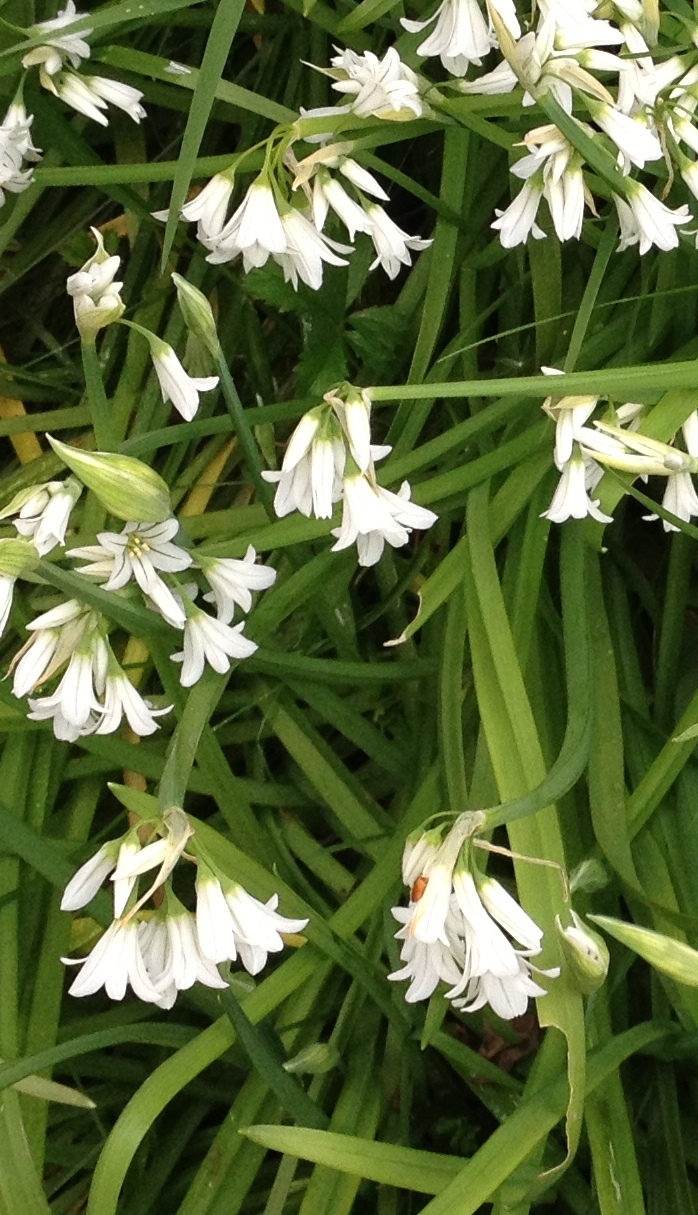
Three-cornered Leek
Allium triquetrum
And so, back to the trusty wildflower guide I went. It turns out that although this is sometimes referred to as wild garlic, it is more usually called Three-cornered Leek. It is closely related to the other plant I had in mind, though, which also goes by the lovely name of Ramsoms. Like Ramsoms, the three-cornered leek is completely edible, and tastes (and smells) a bit like spring onions. So I wasn't wrong, calling it wild garlic, but I wasn't quite right either.


By now I was looking very closely at the plants in the hedges and banks we were passing, trying to name as many plants as I could. This small blue-flowered plant is a very familiar one, and I tried several names on it, but none of them seemed quite right. It wasn't a type of violet, or a bugle, or a speedwell, or any of those small blue flowers. So what was it?

Ground Ivy
Glechoma hederacea
It turns out that its name is one I know well, but have always misapplied. This is Ground Ivy. Not an ivy at all, but a member of the mint family, the Lamiaceae. It is also known by the wonderful names of Gill-over-the-ground and Creeping Charlie. Like the two plants above, it is edible as a herb or a salad ingredient, but it was also used in beer-making before hops were substituted,  and is still used in herbal medicines as a remedy for colds and diarrhoea. Apparently, it can even be used in cheese-making as a substitute for rennet!


So, three new names for me. In fact, many more names, with all the variations. And isn't it interesting how these plants all have the names of other plants in their own? Names which describe relationships that are beyond the biological. And now I know their names properly, when I meet them again I can greet them as friends, rather than nameless faces in a crowd.

In his 2012 TEDxExeter talk, the writer and environmental campaigner Tony Juniper suggested that it would be a very valuable thing for the environment to introduce a Natural History GCSE. I think this is a fabulous idea. And it should be a compulsory subject, even if taking the exam wasn't obligatory. When I was at school in the 70s, there was a subject called Environmental Studies. I have no idea what it involved because only the people who couldn't manage the 'academic' subjects got to do it. I feel that says a lot about where the disconnect between the environment and the average person might have arisen. Knowledge creates relationships. Knowing the names of the plants in the hedgerow or the fish in the sea, knowing their lifecycles and their place in the Earth's ecosystems makes us more connected with them. And if we could create that relationship between people and nature from an early age, we would stand more chance of bringing up committed stewards of the Earth and its resources.

Thursday, 16 May 2013

Easy to Find: Three Good Things (Day 5)

It's so easy to find three good things in nature at this time of year. Plants are just bursting out everywhere. Birds are filling the sky with their songs. The days are getting longer and warmer. This challenge would be harder, but perhaps more creative, in the short wet days of winter. January would be a good time to do it: it's always so grim, with Christmas over and Spring so far away, the weather still getting colder and wetter, and that feeling that the fresh start you're supposed to have made is just going to be such drudgery and tedium.

But in May, it's easy. I don't even have to walk out of my front door to find three things. Whilst still lying in bed, I can hear the birds warbling and trilling as the grey light of dawn filters through the curtains. I go downstairs and open the sitting room curtains, and I can see a blackbird nesting in the climber outside. Where ivy has started creeping over the window I can see the rough brown protrusions it uses to adhere to the glass.


I haven't got any photos of these, though, so as an bonus, here is a picture of some ferns trying to be seahorses...


Wednesday, 15 May 2013

Three Good Things (Day 4)


Cow Parsley or Queen Anne's Lace
Anthriscus sylvestris
Cow parsley. One of the plants of my childhood. Each little floret of cow parsley has one petal that is larger than the others.  It's part of the carrot family, and grows up to a metre tall. The verges and hedges are full of it around here at this time of year, bobbing and swaying in the wind.


New ferns unfurling
I always think it's magical, the way ferns uncurl into magnificent leaves: they look almost like small animals. Sometimes you will find a clump of them on the hedgerow all facing in one direction, looking a lot like a gang of expectant meerkats.


Ivy-leaved Toadflax
Cymbalaria muralis
There is masses of this growing on a wall in the lane outside our house. It propogates itself in an unusual way. Before fertilisation, the flower stalk is phototropic, and moves towards the light. After fertilisation it reverses this tendency and becomes negatively phototropic. This results in the seed being pushed into cracks or dark crevices where the conditions are right for germination and growth. Amazing!

Tuesday, 14 May 2013

Three Good Things (Day 3)

The song of a cuckoo - the first I've heard this year.

The colour of very new oak leaves -  a soft ochre.

The way daisies close up in the rain.

Monday, 13 May 2013

Three Good Things from Nature: Holes in the Ground

After yesterday's mini resolution to connect more with the natural environment by noticing and noting, I spent some time on Monday looking at holes in the ground.

The question I asked was: What lives here?
I don't have answers, but after a bit of research, I do have some ideas.


3 - 4cm diameter, in flat ground.
Mouse, rat? Seems quite big for a mouse. Possibly a weasel?


About 2cm wide, in a low bank.
The dead laurel leaf was partly obscuring the hole until I moved it.
A deliberate attempt at camouflage?
Mouse or vole perhaps?


Three holes, each less than 1cm diameter, in a low bank.
Probably made by ground bees.

It took me about ten minutes to find these three different animal homes. Not much time out of my day to take time to connect, to notice, to take note. And doing so gave me real pleasure.

Noticing and Noting Nature: The Experience of Being Alive

I love Twitter. I love the way it gets me reading such interesting things, blogs and articles I would never have found if I'd just been surfing the web all alone. Last week I was quite unwell with a double whammy of a throat infection and a chest infection, so the old attention span was, at the best, minimal. But Twitter is great. 140 characters - I could manage that! And browsing through my Twitterfeed I found links to two articles that made me think. Both were concerned with the way we connect with the natural world, and how this can be beneficial to our health and well-being.

The first article was by by Adam Frank, an Astrophyicist at the University of Rochester. On the 13.7: Cosmos and Culture website, Adam talks about how we lead such busy, frantic lives that we miss out on the experience of actually being alive:
In this permanent state of hyperventilation, the issue for us all is not stopping to smell roses. It's not even noticing that there are roses right there in front of us. Joseph Campbell, the great scholar of religion, hit the core of our problem when he wrote, "People say that what we're all seeking is a meaning for life. I don't think that's what we're really seeking. I think that what we're seeking is an experience of being alive."
Adam's answer to this problem is to make time to seek out your inner 'scientist', the scientist you were when you were a child, when you noticed stuff all the time, and asked endless questions about the way things are. When you were so close to everything that it almost seemed part of you. This is how you start experiencing being alive again:
This is where it begins, with simple act of catching seeing the smallest detail as an opening to a wider world of wonder and awe.
He suggests a walk in the woods is the best way to find that world of wonder and awe, a walk where you open you mind to what you can see. He suggests counting things (trees, petals), listening attentively, noticing patterns, colours, shapes. And it doesn't need to be a passive activity -  he suggests climbing onto a branch of a tree to get a different perspective, taking notes, making drawings.

It struck me very forcibly, though, that he wasn't just describing the inner scientist. He was also describing the inner poet. Isn't that what poets do? Notice things? Look at things differently? See the patterns and the strangenesses? Write them down? It certainly is. Adam Frank says that although not everyone can be a Scientist with a capital letter, they can be a scientist. And I say, in the same way, everyone can be a poet.


Look closely at a dead tree stump.
Why is some of it rotten and crumbling,
while the rest is still strong?

The second article that I came across, by Applied Psychologist Miles Richardson in Finding Nature, is very closely related to this idea of finding your connection to life in close attention to nature and its infinite detail. However, it goes one step further by suggesting that connecting to the natural world will make people more likely to want to live in a way that promotes environmental sustainability. To quote from the Finding Nature website:
The first finding nature research paper was published Februrary 2013 in the Humanistic Psychologist and is available online. It explores the rewards of nature that can be found in a familiar semi-rural landscape. The case-study paper informs current quantitative research which will explore practical ways to connecting to nature in the local landscape, which is more sustainable and fits better with the everyday lives of many. As an emotional connection to nature predicts pro-environmental attitudes and behaviour, the work presents a simple first step towards more sustainable human behaviour through a connectedness to the local landscape; so that, for once, our own well-being might lead to natures well-being.
Richardson, M., and Hallam, J. (2013). Exploring the Psychological Rewards of a Familiar Semi-Rural Landscape: Connecting to Local Nature through a Mindful Approach. The Humanistic Psychologist, 41(1), 35-53.


Read more: http://www.findingnature.org.uk/
Create your own website for free: http://www.webnode.com
The first finding nature research paper was published Februrary 2013 in the Humanistic Psychologist and is available online. It explores the rewards of nature that can be found in a familiar semi-rural landscape. The case-study paper informs current quantitative research which will explore practical ways to connecting to nature in the local landscape, which is more sustainable and fits better with the everyday lives of many. As an emotional connection to nature predicts pro-environmental attitudes and behaviour, the work presents a simple first step towards more sustainable human behaviour through a connectedness to the local landscape; so that, for once, our own well-being might lead to natures well-being.
Richardson, M., and Hallam, J. (2013). Exploring the Psychological Rewards of a Familiar Semi-Rural Landscape: Connecting to Local Nature through a Mindful Approach. The Humanistic Psychologist, 41(1), 35-53.


Read more: http://www.findingnature.org.uk/
Create your own website for free: http://www.webnode.com
The first finding nature research paper [...] explores the rewards of nature that can be found in a familiar semi-rural landscape. [...] As an emotional connection to nature predicts pro-environmental attitudes and behaviour, the work presents a simple first step towards more sustainable human behaviour through a connectedness to the local landscape; so that, for once, our own well-being might lead to nature's well-being.  (1)


So far, so good, you might say. That makes sense - indeed it might be considered stating the obvious. (Although research has proven that the 'stating the obvious' response is often fundamentally flawed!) However, Miles Richardson is going one step further. As part of his new research project he has released an Android app which aims to 'measurably increase people's connection to nature'. The app tests how connected people feel to nature before they begin using it, and then encourages them to note three good things in nature each day for five days. This can be written notes, or a photo, 'be it the song of a robin or the first buds of spring'. After five days it measures how much more connected the user feels, and encourages them to share their notes and experience via Twitter. And this is part of a greater research purpose. To quote again:

Developing a closer connection to nature is great for our wellbeing and our attitudes towards conservation, but users are not just helping themselves: by opting in, you can take part in a study of people’s interactions with nature run by researchers at the University of Derby, helping them to find the best ways to encourage people to connect with nature.

At present there is only an Android app, but if it takes off, an  iPhone version might be forthcoming, and the researchers are also working on a web-based version with email prompts.

I thought this was a brilliant idea, incorporating the technology that has become so embedded in our lives to help people make a connection with nature, and thus encouraging them to become more positive about caring for the environment. And it linked so nicely to Adam Frank's article about practising noticing, that I decided I'd incorporate a version of both into my life and this blog, despite the fact that I don't have an Android device.

So yesterday, the first day I really felt well enough to go out of the house, I took a little walk around the garden and the village with the purpose of noticing and noting three good things in nature. I took photos, and chose three good things to share. Here they are:


An enormous fallen willow branch,
on a pile of wood waiting to be logged.
So full of life that it is shooting after being cut.

Apple blossom.
Foreshadowing the fruit.

The amazing angles and shapes of thistle in the hedgerow.
Spiky fractals.
Eccentricity and concentricity
Of course, I'm lucky. I live in the country, and I feel pretty connected with nature already. But I don't always pay close attention. And I don't always make time to look and notice. So this mini resolution to note three good things a day will help me to experience what I have. 

And I believe that anyone can do it, whether they live in the country or the city. Nature is everywhere, from the breathy cooing of pigeons on the rooftops, to the lone dandelion forcing its way through broken concrete, to the smell of the rain on dry ground. There's even a word for that last one: petrichor. So, let's make time to go out and notice it!

(1) Richardson, M., and Hallam, J. (2013). Exploring the Psychological Rewards of a Familiar Semi-Rural Landscape: Connecting to Local Nature through a Mindful Approach. The Humanistic Psychologist, 41(1), 35-53

All photos © Sally Douglas